The One-Touch Grocery Put-Away: Streamlining Your Kitchen’s Inventory Pipeline
For most families, the “grocery cycle” is a multi-stage ordeal. You spend an hour shopping, leave the bags on the counter for another hour, and eventually “stuff” items into the pantry wherever they fit. This haphazard approach creates a “logistics bottleneck.” You end up with three open boxes of crackers, hidden jars of sauce that expire before they’re used, and a kitchen that feels cluttered even when it’s “clean.”
As the Household CEO, you need to treat your grocery delivery or shopping trip like a professional Inventory Pipeline. By applying the One-Touch Principle, you can reduce the time spent on chores and ensure your Kitchen Systems run with industrial precision.
The Science: The “One-Touch” Rule and Lean Logistics
In lean manufacturing, the “One-Touch” rule suggests that an item should only be handled once between its arrival and its final destination. Every time you pick up a box of pasta just to move it out of the way, or put a carton of eggs in a “temporary” spot in the fridge, you are wasting Motion Economy.
Research on “Process Efficiency” shows that minimizing “touches” significantly reduces errors and physical fatigue. In your home, this means that the moment a grocery bag enters the kitchen, every item should move directly to its “Single Source of Truth”—its permanent home.
Step 1: Pre-Restock Staging (The “Clean Slate”)
Before the new inventory arrives, you must prepare the “warehouse.”
- The Routine: Spend two minutes doing a “Quick Scan” of the fridge and pantry. Consolidate half-empty containers and move older items to the front (the FIFO method we discussed in Article 4).
- The Logic: You cannot efficiently stock a messy shelf. By “staging” the space first, you ensure the new “one-touch” movement is frictionless.
Step 2: The “Decanting” Strategy
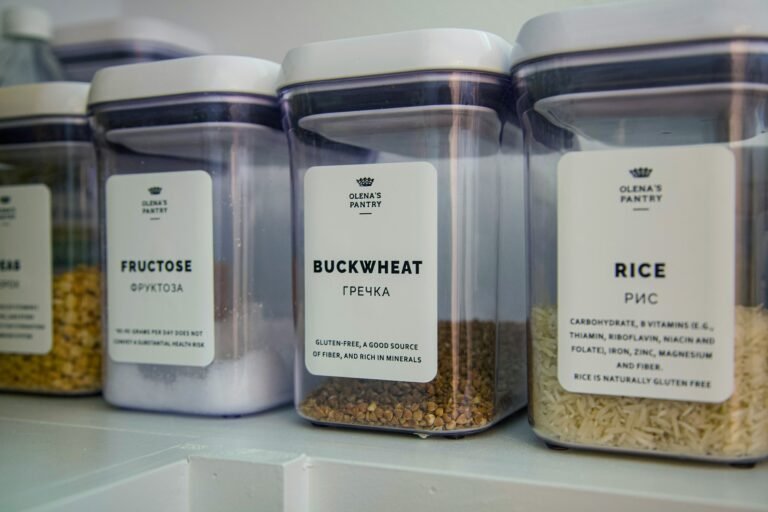
One of the biggest sources of visual noise and “micro-friction” is original packaging. Boxes are bulky, hide the actual inventory level, and make it hard to see what you have.
- The System: For high-velocity items (pasta, cereal, snacks, baking supplies), decant them into clear, uniform containers the moment they come out of the grocery bag.
- The ROI: This is the ultimate “One-Touch” move. You handle the item once to put it in the bin, and from that point on, you have a visual “Kanban” signal that tells you exactly when you need to restock.
Step 3: Zone-Based Unloading
Don’t unload bags one by one. Sort the bags by Zone as they come in:
- Zone 1: The Cold Chain (Fridge/Freezer)
- Zone 2: The Dry Pantry (Grains/Cans)
- Zone 3: The Household Ops (Cleaning supplies/Paper products) By grouping the bags, you eliminate the “back-and-forth” travel time across the kitchen. You stay in one zone until it is finished, then move to the next.
Step 4: Trash At The Source
Packaging is the “waste” of the inventory pipeline.
- The System: Keep a recycling bin or trash can within arm’s reach of your unloading station.
- The Execution: Strip away the outer cardboard from yogurt packs, soda cans, or snack boxes before they go into the fridge or pantry.
- The Logic: You are “processing” the waste at the point of entry, so you never have to deal with empty boxes taking up space in your systems later.
The ROI: Reclaiming the “Post-Shop” Fatigue
The goal of the One-Touch Put-Away is to eliminate the “clutter hangover” that usually follows a grocery run. When you treat your groceries as a strategic inventory move, the kitchen stays organized by default. You aren’t just putting food away; you are “arming” your kitchen for the upcoming week’s 15-Minute Meal Framework.
By acting as the CEO of your household logistics, you ensure that every item in your home has a purpose, a place, and a plan. You stop managing messes and start managing a high-performance environment.